
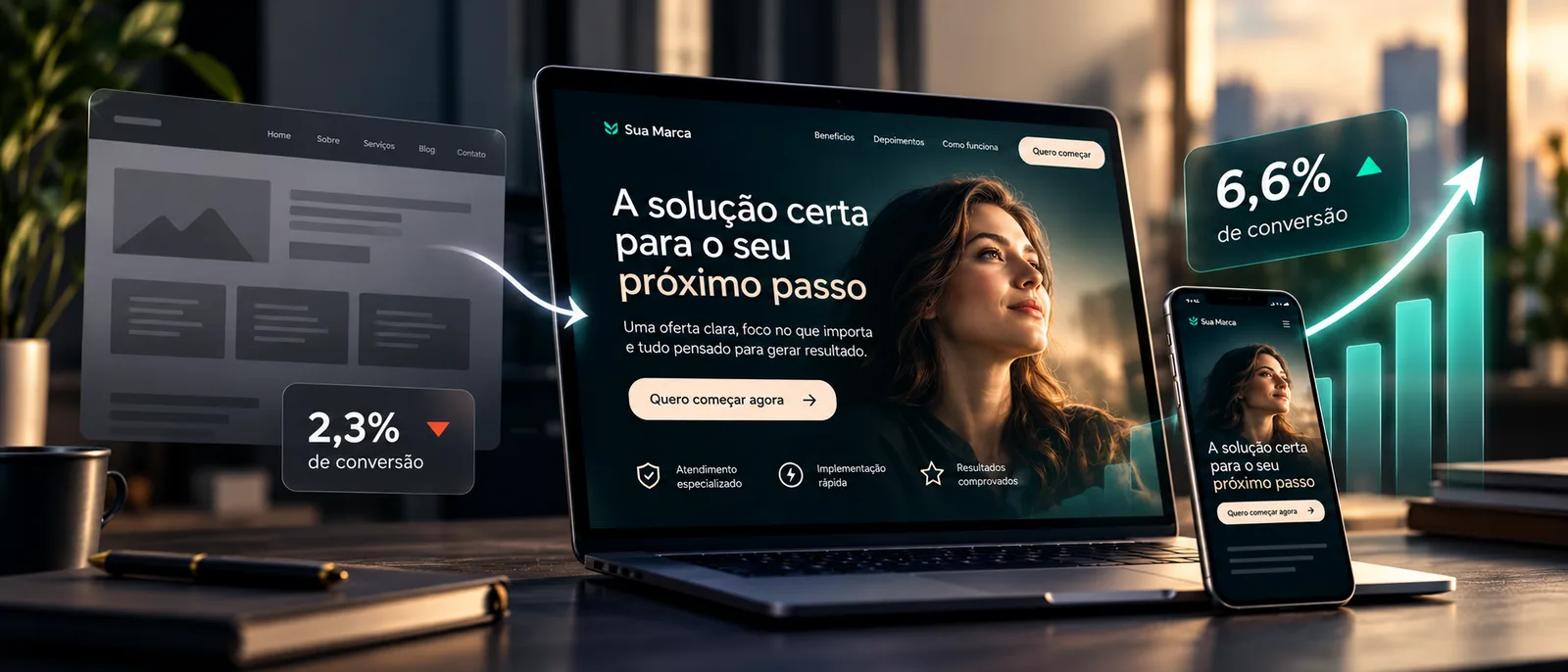
If you run a business, a private practice, a service, or a specific offer, and you still send everyone to the same place (Instagram, a direct WhatsApp message, or your institutional homepage), you are leaving money on the table. This is not opinion, it is what the numbers show.
If you are not sure exactly what a landing page is, I already covered that here. This article is about why having one (or several) changes the outcome for your business.
1. It converts three to ten times more than a generic homepage
According to Unbounce's benchmark report, based on 41,000 landing pages and 464 million visits, a dedicated landing page converts at a median of 6.6%. A traditional institutional homepage, trying to speak to everyone about everything, converts somewhere between 2% and 3%. Same amount of traffic, completely different result.
2. The best ones convert above 11%, and it is not luck
In the same Unbounce report, the top 25% of landing pages convert above 11.45%. The difference between those pages and the rest is not creativity, it is focus: one offer, one audience, one button. Fewer choices means fewer people giving up halfway through.
3. The decision to trust you happens in 50 milliseconds
A study from Carleton University, in Canada, measured that exact window: 50 milliseconds is how long it takes someone to form a first opinion about a website, before they can even read the headline properly. The Stanford Web Credibility Project found another uncomfortable number: around 75% of people judge a business's credibility by its website design, not by its content. That judgment is already made before you get the chance to make your case.
4. Load speed is part of the sales pitch
An online store that loads in 1 second converts at 3.05%. The same store, loading in 5 seconds, drops to 1.08%. Every extra 100 milliseconds already cuts into conversion, and a large share of traffic simply gives up before seeing anything: according to Google, 53% of mobile visits are abandoned when a page takes longer than 3 seconds to load. I showed this in practice, with real numbers from my own site, in this article on Core Web Vitals and conversion.
5. Over 60% of your visitors are on a phone
According to Statista, mobile traffic already accounts for roughly 62% to 64% of all website visits worldwide. A lean landing page, without a long menu or a generic section to navigate, works far better on a small screen than an entire institutional site trying to fit under someone's thumb.
6. Every paid campaign gets cheaper with the right page
If you advertise on Google, your landing page also decides how much you pay per click. Google Ads itself explains that Quality Score factors in landing page relevance, and advertisers with a "below average" rating pay 30% to 70% more in CPC than those rated "above average". Sending paid traffic to a generic homepage instead of a page built for that specific offer makes every click you are already paying for more expensive.
7. More conversion pages means more leads, not just more work
A classic study from HubSpot, based on data from thousands of businesses, found that companies going from 10 to 15 landing pages saw a 55% increase in leads generated. Each offer, each campaign and each audience deserves its own page, not one homepage trying to serve everyone at once.
8. One single path, with no menu to get lost in
A homepage has a menu, several sections, several possible exits. Every extra option is a chance for someone to leave without doing anything. A landing page removes that decision from the path: the person arrives, understands the offer, and only has to decide between continuing or leaving. That alone already cuts the friction that makes someone close the tab halfway through.
9. It works like a salesperson available 24 hours a day
A well-built landing page explains the offer, answers the main objection and leads to action without needing anyone online to answer a message. It does not replace real support, but it keeps an interested person engaged until you can respond, instead of letting that person cool off while waiting for someone to see the DM.
10. Even small, you come across as a bigger, more structured business
This is the reason I hear most from my own independent clients: a small practice, a law office with just a few people, a solo professional. Since 75% of people judge credibility by design alone (reason 3), a well-built landing page changes the perception of size and structure before any conversation even happens, even when the business behind the screen is small.
How this looks in practice
I have already applied this logic to real projects. The landing page for Meditar Pleno 2026 and the one for Toque Quântico Masterclass exist to sell one single thing, to a specific audience, with no distraction from a menu or a generic "about the company" section. You can see the rest of the projects I have delivered in the projects section of my site.
If you already have an institutional site, that is fine, it still serves its purpose. But an institutional site and a landing page solve different problems. One presents the whole company. The other exists to convert a specific offer, for a specific audience, at a specific moment. Anyone relying only on the first one is using the wrong tool every time they run a campaign, launch a new service, or open up space in their schedule.
My schedule is open for new projects right now. If your business, or your work as a professional, still does not have a landing page, or has one that does not speak to anyone in particular, message me on WhatsApp and let's design the page that turns visits into customers.

Graphic designer. I write about brand, form, and craft, what holds an identity together on any surface.